A CSX mechanical employee tests onboard equipment. The two cab display units shown provide the locomotive engineer an interface to the PTC system.Photo – CSX Corp.
By
Much has been accomplished over the past nine years, but there’s still so much left to do. That sums up the progress of positive train control (PTC) implementation for the more than three dozen Class Is and commuter railroads that are federally required to adopt the technology by what’s now a rapidly approaching deadline.
Federal Railroad Administration (FRA) data through the first quarter shows freight railroads had made a considerable dent in their to-do lists earlier this year. They installed 14,253 (or 87 percent) of 16,456 radio towers, equipped 8,902 (or 48 percent) of 18,568 locomotives with PTC devices and trained 85,777 (or 66 percent) of 130,038 employees on PTC operations. Likewise, commuter roads through the quarter had installed 684 (or 52 percent) of 1,322 radio towers, equipped 1,785 (or 45 percent) of 4,006 locomotives and trained 13,302 (or 52 percent) of 25,690 employees.
But there’s another critical work item that will require more effort to complete: placing additional route miles into PTC operation. Through the first quarter, freight railroads had 15,558 miles (or 27 percent) of 57,800 miles and commuter roads had 1,006 (or 23 percent) of 4,321 miles in such operation.
With the federal deadline of Dec. 31, 2018, looming, there isn’t that much time left to finish everything. The railroads’ only other option is to acquire all radio spectrum and install all hardware by 2018’s end to be eligible to apply to the FRA for a two-year extension. PTC is designed to prevent certain train-to-train collisions, over-speed derailments, incursions into established work zone limits and trains positioned on the wrong tracks because of an incorrectly thrown switch. Class Is and commuter railroads are eager to derive those benefits from the technology — and the billions of dollars they’re investing in it. So, they’re doing all they can to get their systems in place, the railroads say.
Deadline driven
For example, BNSF Railway Co. is hammering away at implementation to complete all work by the deadline, says Chris Matthews, the Class I’s assistant vice president of network control systems. The railroad expects to spend about $2 billion to fully install the Wabtec Corp.-developed Interoperable Electronic Train Management System (I-ETMS®) that all the Class Is and many commuter railroads are adopting.
Through the third quarter, 78 of 90 subdivisions and 10,263 of 11,300 miles of track were in PTC revenue service, and crews had equipped 4,849 of 5,000 locomotives with required onboard devices. The entire PTC project calls for implementing the technology on half of BNSF’s network, says Matthews.
After implementation is completed, about 80 percent of annual volume will be moved in PTC territory, he says. Through Sept. 30, the Class I had completed 800,000 train trips in that territory.
Heading into the home stretch, BNSF will need to continue to sort out interoperability issues with dozens of other railroads, and work through technical enhancements to onboard and back-office systems, says Matthews.
“We’ll need technical fixes to harden the [PTC] system. It will help us get ready for prime time,” he says.
Union Pacific Railroad has about 1,000 employees and contractors working on its I-ETMS system to ensure the Class I is PTC-ready come 2019, as well.
They posted progress in Q3: Thirty-one additional track segments were prepared for PTC, bringing the total number of finished segments to 135, or 73 percent of the goal. In addition, crews placed another 1,700 route miles in PTC operation, increasing the completed total to 7,559 miles (or 43 percent of goal), and teams trained more than 2,800 workers, raising the total trained to 18,800 (or 59 percent of goal).
Implementation progress as of Sept. 30 showed 4,490 locomotives were outfitted with PTC hardware and software (79 percent of goal), and 5,656 locomotives (or 94 percent of those earmarked for devices) were equipped with hardware. In addition, crews had installed more than 99 percent of wayside antennas, equipped 87 percent of required radio towers with PTC technology and added necessary signal hardware to 98 percent (or 17,130 miles) of required route miles.
This year, UP has budgeted about $300 million for PTC, which in total will cost the Class I about $2.9 billion.
Eye on 2020
Norfolk Southern Railway forces also made headway on I-ETMS implementation through Q3. The engineering team installed 3,360 radio towers, 3,382 wayside interface units, 3,106 wayside radios, 382 base station radios and 105 switch-position monitors.
The through-Q3 scorecard for the mechanical team shows members installed and readied 2,324 locomotives with onboard computers, 2,250 locomotives with PTC displays, and 2,059 locomotives each with PTC-capable event recorders and radios. In addition, 2,059 locomotives were fully equipped and PTC-operable.
Meanwhile, NS’ operations team through the quarter had trained more than 17,325 employees and their supervisors on job-specific PTC duties. In addition, workers continued to verify and validate NS’ system at an Atlanta PTC lab. Through Q3, they tested more than 12,365 scenarios of PTC states and functions, and more than 131 iterations of software releases.
As of Sept. 30, NS was operating PTC-equipped trains in revenue service on 2,022 miles of track. The Class I also continued to work with 30 other railroads on interoperability. According to the FRA’s list of railroads’ planned timelines, NS is expected to apply for an extension and complete implementation by Dec. 31, 2020.
So is CSX, which through September had spent about $1.96 billion on implementation. The Class I estimates it’ll spend $2.4 billion on the technology by 2020’s end.
Currently, nearly half of CSX’s PTC footprint — or about 6,100 track miles — is operating in revenue service. As of Sept. 30, the Class I had activated and placed into revenue service 51 subdivisions representing 47 percent of the track miles in its footprint.
The railroad has installed about 80 percent of its wayside interface units and base station radios, and made more than 2,100 locomotives PTC-capable. In addition, CSX’s PTC team recently secured federal approval for the 434 required communication towers.
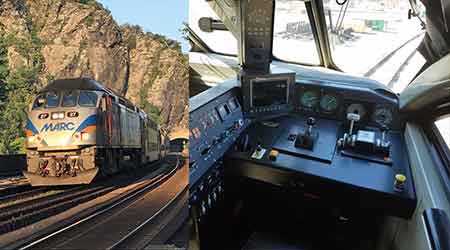
The Maryland Area Regional Commuter agency plans to equip 32 diesel locomotives and 35 cab cars with I-ETMS onboard devices.
Maryland DOT/ Heather Roman
Meanwhile, CSX is one of the host railroads the Maryland Area Regional Commuter (MARC) agency continues to work with to install an I-ETMS system. The others are Amtrak and NS (via Amtrak-owned track). The host railroads are handling wayside devices, while MARC is installing onboard equipment and a back-office system.
Halfway home
The commuter railroad will need to equip 32 diesel locomotives and 35 cab cars with onboard devices, says MARC Chief Mechanical Officer Dean Del Peschio. The PTC work is about halfway finished, with full completion expected in third-quarter 2018. A challenge MARC has overcome during implementation: dealing with nine different types of equipment, including three generations of cab cars and two locomotive types, says Del Peschio. “We worked through engineering and design to solve that,” he adds.
Now, MARC is in the midst of procuring its back-office system, which likely will be obtained sometime next year.
“Then, we’ll move into testing [in third-quarter 2018], which will be coordinated with our host railroads,” says Del Peschio.
The Massachusetts Bay Transportation Authority (MBTA) also is working with CSX and Amtrak. The parties are trying to resolve spectrum mitigation issues as the agency continues to install an Advanced Civil Speed Enforcement System II (or ACSES II) developed by Alstom.
In late 2015, the MBTA awarded a contract to Ansaldo STS USA Inc. to design and install the system, which so far has been has adopted on the Newburyport/Rockport, Lowell and Needham lines.
According to the FRA’s list, the MBTA is expected to apply for an extension to 2020’s end. Through 2018, PTC-related hardware installations will continue along all the authority’s lines. Then through 2020, the MBTA plans to install software and complete other technical elements needed to bring the system online.
Last month, the authority announced it secured $382 million in federal loans from the Transportation Infrastructure Finance and Innovation Act and Railroad Rehabilitation and Improvement Financing programs for PTC implementation. The loans will be issued under a combined commitment agreement — a first for the two federal programs.
Put to the test
New Jersey Transit also is working with Amtrak while implementing PTC because some of the agency’s 600-plus miles of track run along the Northeast Corridor. Amtrak is governing PTC work on the corridor.
NJ Transit expects to spend about $320 million to install an ACSES II system on 326 miles by the end-of-2018 deadline. The agency has contracted Parsons Transportation Group (PTG) to implement the system, with Alstom serving as a technical subcontractor. Devices will be installed on 440 vehicles, including locomotives and cab cars.
As of Sept. 30, 24 of 124 radio towers were erected, 137 of 1,100 workers were trained and 37 vehicles were PTC-ready.
Equipping vehicles has posed challenges, but PTG recently added capacity to test vehicles, says NJ Transit Executive Director Steven Santoro. In addition, training all workers — including 420 engineers and dozens of equipment and site maintainers — continues to be daunting. So, NJ Transit recently installed three simulators in Newark that incorporate PTC into training, says Santoro.
Earlier this year, tests on portions of the PTC software went well, so the agency obtained FRA approval to test the ACSES II system on 6 miles of the Morristown Line. Tests will begin in January and last about three months using non-revenue trains.
“It will be a full system integration test, with all parts talking to each other,” says Santoro.
Helping each other out
Successful tests also were key for Metrolink to notch a recent interoperability achievement with BNSF. In October, both railroads began operating revenue service trains across portions of each other’s PTC-equipped properties. Since the operations have gone smoothly, the two roads now run trains on each other’s PTC-operable lines each day, says Metrolink Director of Network Train Control Systems Jay Peterson.

As part of its $2 billion PTC project, BNSF installed necessary equipment along Mendota Subdivision trackage between Aurora and Galesburg, Illinois.
BNSF Railway Co.
In 2015, Metrolink launched PTC operations across its entire 341-mile territory. The commuter railroad also operates on track owned and/or dispatched by BNSF, UP, Amtrak and the North County Transit District in San Diego County, California.
About a year ago, BNSF and Metrolink began testing work for the cross operations in integrated labs. The railroads upgraded their interoperable train control messaging systems, established new security layers and performed other necessary tasks.
Now, Metrolink is performing integrated testing with UP on a new security layer and expects to field-test cross operations soon, says Peterson. Similar efforts with Amtrak will begin “when they’re ready,” he adds.
The Rio Metro Regional Transit District (RMRTD), which governs the Rail Runner Express in central New Mexico, already is working with BNSF and Amtrak on a PTC-related project. The three parties have teamed with engineering firm WSP USA to develop a risk mitigation plan that would provide the agency more time to adopt PTC, says RMRTD Director Terry Doyle.
The FRA rejected RMRTD’s PTC exemption request, but later suggested the agency develop a risk mitigation plan that would help reduce certain criteria below safety thresholds, such as the amount of freight tonnage moved on its line, he says. A temporary measure, the plan would enable RMRTD to complete PTC implementation after the deadline, says Doyle.
Although working on both the mitigation measures and PTC simultaneously is daunting, “the plan will help us work toward implementation,” he says.
RMRTD needs to install PTC on 97 miles of track, equip nine locomotives and nine cab cars, and establish a back office system. By year’s end, the agency expects to issue an RFP for a contractor that could tailor a system for RMRTD, most likely based on I-ETMS, says Doyle.
The contractor will be selected by March, with some installation work starting next year.
“Our goal now is to begin service demonstration in the fourth quarter of 2020, and then finish up by the end of 2020, or perhaps roll into 2021,” says Doyle.
Until recently, RMRTD was facing a high degree of uncertainty with PTC because the state owns all its track and funding was in question, says Doyle. But the agency has identified some financing solutions, such as taking on debt, he says.
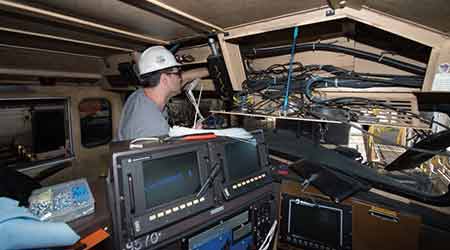
An NS electrician installs PTC equipment in a cab at a locomotive shop in Chattanooga, Tennessee. Through Q3, 2,059 NS locomotives were fully equipped and PTC-operable.
Norfolk Southern Corp./Casey Thomason
It’s going to take a lot more problem-solving for the railroads to be ready to handle the technology once PTC is entirely in place. At BNSF, that means coming up with ways for all departments to function in unison prior to full implementation.
Since each department will operate a bit differently with PTC, employees now can practice their tasks as much as possible, acting as if the mandate already was in effect, says BNSF’s Matthews.
“We’ve built this complex system of systems, so now we need to support it,” he says. “We want to make sure everyone understands their role in it.”
Email questions or comments to
Ensuring they completely install their PTC systems by the federal deadline is an onerous endeavor for Class Is and commuter railroads. For short lines, meeting PTC requirements equally poses “a real challenge,” says American Short Line and Regional Railroad Association (ASLRRA) President Linda Darr.
Short lines have until Dec. 31, 2023, to fulfill their requirements. The Positive Train Control Enforcement and Implementation Act of 2015 amended the Rail Safety Improvement Act of 2008 (RSIA) in part to provide qualifying small railroads an additional three years to comply.
But there aren’t that many short lines that need to adopt PTC devices or components because of the RSIA, says Darr. Of the 100 or so small roads that need to comply, only nine or 10 are impacted by the law.
The rest are taking on PTC “because their Class I partners say they need to,” says Darr. Those small railroads need to install the appropriate devices on their locomotives to meet interoperability requirements.
“Short lines don’t think this is fair. But for now, we’re full speed ahead on this [compliance],” says Darr.
Moreover, many small roads need to pay “large sums of money” to cover insurance, user fees and other costs associated with accessing the nationwide PTC communications platform the Class Is have adopted, she says.
For example, several short lines need to only equip five locomotives with PTC devices to comply with a Class I. Yet, they will spend about $1 million on communication charges at startup, and almost that much annually, says Darr.
In certain cases, “that’s only so they can travel a mile or two on a Class I’s network once or twice a week,” she adds.
The ASLRRA plans to continue focusing attention on short lines’ PTC concerns next year while working with legislators and regulators.
— Jeff Stagl